Woman glasses code reflection technology face eye screen

Online content reviewers help keep digital spaces safer, but the work can come at a high psychological cost. Repeated exposure to disturbing content, combined with intense workloads, algorithmic monitoring and precarious working conditions, can increase the risk of stress, burnout and trauma-related symptoms.

A new OSHwiki article explores these psychosocial risks and the measures that can help protect workers, from limiting exposure and ensuring adequate breaks to psychological support, better work organisation and greater worker involvement.

Read the OSHwiki article on online content reviewers and mental health at work.

OiRA icon illustrating teachers

High workloads, emotional demands and exposure to violence can put teachers and other education staff under considerable strain. For schools and education institutions, the start of the school year is a timely moment to take stock of these pressures alongside other occupational safety and health risks and strengthen prevention.

OiRA can help. Free online risk assessment tools for education are available in several countries, covering different settings and activities. They guide organisations through identifying and assessing risks and deciding what action to take. Education-specific OiRA tools are also available at EU level: ETUCE and EFEE, in cooperation with EU-OSHA, have developed three tools covering Early Childhood Education, Secondary Education, and Higher Education and Research.

EU-OSHA’s report on psychosocial risks in education looks more closely at the work-related factors affecting teachers’ well-being and how they can be addressed. Its findings underline why psychosocial risks should be part of a comprehensive workplace risk assessment, alongside other occupational safety and health risks.

Explore the available OiRA tools for education and find the one relevant to your country and activity.

Tired worker in extreme heat

EU-OSHA’s new discussion paper reviews the effects of climate change on occupational safety and health (OSH) and its unequal impacts on different workforce groups.

20260903-NR-eu-osha-move-new-headquarters.jpg
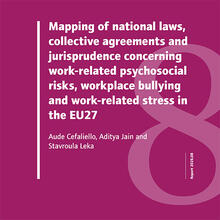
Cover of the report

Workplaces in Europe have changed significantly in recent decades, from the digitalisation of work to the expansion of certain sectors. Alongside these changes, psychosocial risks (PSRs) at work have been on the rise. But how is this reflected in national legislation across the EU?

A new report from the European Trade Union Institute (ETUI) maps national laws, collective agreements and jurisprudence on work-related PSRs, workplace bullying, and work-related stress in all EU Member States.

Read the full report

Learn more about EU-OSHA’s upcoming campaign ‘Together for mental health at work’

Ernesta.Petrauske [at] vdi.lt
Brussels
Belgium
Roxana Mînzatu and William Cockburn

Executive Vice-President of the European Commission, Roxana Mînzatu, has inaugurated EU-OSHA’s new offices in the centre of Bilbao. During her visit, she discussed key occupational safety and health challenges with staff and management, including AI, heat at work and psychosocial risks. She also highlighted the role of innovation in creating safer and healthier workplaces.

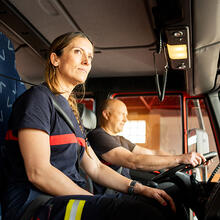
Woman and man at work

Gender can influence both the psychosocial risks to which workers are exposed and the way in which these risk factors affect them. This is the focus of this latest OSHwiki article.

The concentration of women and men in different sectors and positions within organisational hierarchies can limit career paths, directing women and men towards distinct roles with gender-specific psychosocial risks. How workers are affected by these risks also varies; for example, women report more work-related mental health issues than men.

To address these inequalities, the article offers recommendations for policymakers, employers and OSH professionals.

Read the OSHwiki article

Learn more about EU-OSHA’s upcoming campaign ‘Together for mental health at work’

We are inviting tenders for a comprehensive study on occupational safety and health (OSH) focusing on the prevention of work-related cardiovascular diseases (CVDs), return to work after a CVD, and the retention of workers with chronic CVDs.

The successful tenderer will be required to investigate the occupational risk factors linked to work-related CVDs and to identify the sectors, occupations and groups of workers most at risk, thereby contributing to the development and dissemination of good practice both at policy level and in the workplace.

Check the full details and submit your tender by 10 September 2026 (16:00 CEST).