



© santirj - stock.adobe.com
Climate change and related climate actions are reshaping the world of work, bringing new risks and deep transformations. This foresight study explores how climate change and its wider impacts will influence jobs and workers’ safety and health over the next 25 years. By using scenarios to examine possible futures, it supports policymakers and stakeholders to develop smarter occupational safety and health (OSH) policies, and helps create working environments that remain safe and healthy as climate conditions continue to shift.
Focus of the foresight study
- Examining how OSH policies and practices need to evolve to meet transforming realities of work driven by climate change and related developments.
- Looking beyond direct climate-related risks (e.g. heat stress) to focus on how the adaptation to the ‘new normal’ will affect working conditions.
- Identifying new risks for workers from changing workplaces, schedules, exposures and materials, production processes, and skills needs.
- Providing insights to help policymakers and stakeholders to anticipate new changes and disruptions ─ while safeguarding workers’ safety and health in the decades ahead.
What climate change and related developments means for jobs, workplaces and OSH
- Climate change is transforming how work will be carried out ─ from more frequent droughts or heatwaves, and floods to new disease vectors.
- Moreover, related prevention and adaptation measures, such as redesigned infrastructure, city planning, organisational processes or job types will affect working conditions.
- Climate action such as the European Green Deal, decarbonisation and the shift to a circular economy will strongly influence regions, communities and workplaces.
- Adaptation brings both OSH challenges and opportunities, since circular‑economy activities such as repair, recycling and disassembly can generate sustainable jobs but may also introduce new risks linked to materials, waste handling or transport.
- These impacts are reinforced by broader forces, as migration, geopolitical tensions and economic uncertainty shape how organisations and labour markets evolve.
OSH risks to be addressed
- Health risks related to physical and mental wellbeing, upcoming vector‑borne diseases, and new patterns of exposure.
- Dangerous substances, pollution, and heat stress.
- Demand of stronger resilience and new skills to manage uncertainty, due to business disruptions caused by financial, technical or social instability.
- New technologies and job profiles emerging from climate action (for example green transitions), such as renewable energy, electrification, sustainable construction, resilient urban design and food-system changes.
- Rising inequalities, especially affecting older workers and those with pre‑existing conditions.
Future scenarios
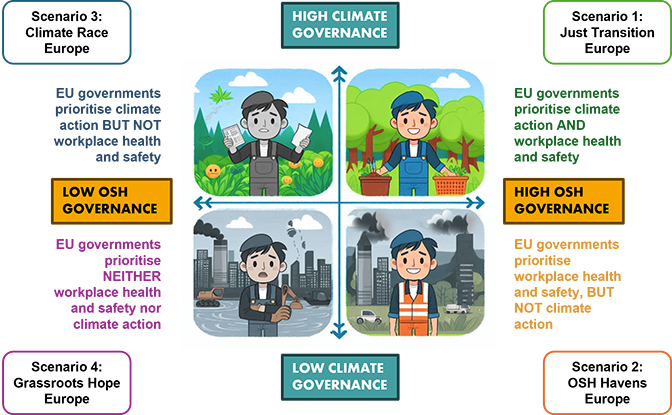
The future scenarios explore the potential indirect impact of climate change on OSH. This method develops several stories about how the future may unfold. These are not predictions, but examples showing how key uncertainties could interact. By illustrating what could happen, the scenarios help people visualise different possible outcomes and reflect on their implications.
Scenario 1 – Just transition: This is a best-case scenario where climate neutrality and strong worker protection advance together.
Scenario 2 – OSH havens: Strong OSH systems coexist with climate inaction, creating deep inequalities and dependence on automation.
Scenario 3 – Climate race: Rushed climate action without OSH safeguards creates significant new risks for workers.
Scenario 4 – Grassroots hope: With weak institutions, worker protection becomes self-organised, highlighting the fragility of relying on non-state action.
While allowing the evidence to guide our scenarios, priority areas for exploration include eco-anxiety, mass migration, the broader economy, technology, climate adaptations, new ways of working and values, and emerging skills and professions.
Related publications
Related publications
14/05/2026
14/05/2026
14/05/2026