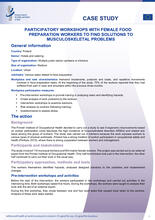
Participatory workshops with female food preparation workers to find solutions to musculoskeletal problems
27/03/2022
- Leadership and worker participation
- Musculoskeletal disorders
- Risk assessment
Kitchen workers are susceptible to musculoskeletal disorders (MSDs) because food preparation tasks involve lifting and carrying loads, as well as awkward and repetitive movements.
This case study from Finland looks at how participatory workshops for kitchen workers can help them to identify, analyse and implement solutions to MSD-related risks. An external expert coordinated a participatory intervention project. It involved carrying out a series of workshops for 504 kitchen workers.
Participants were encouraged to analyse risks, generate solutions and implement changes in the workplace. Over 400 ergonomic changes were made in kitchens.
Related resources
Related resources
Related publications
28/03/2022
04/03/2022
27/03/2022
27/03/2022
27/03/2022
27/03/2022
27/03/2022
27/03/2022
27/03/2022
27/03/2022
27/03/2022
Additional publications on this topic
14/07/2026
14/07/2026
14/07/2026
Carrying out participatory ergonomics
Introduction
This article provides some basic guidance on how to carry out participatory ergonomics in the workplace, in particular for preventing musculoskeletal disorders (MSDs). It draws on a longer article on participatory ergonomics[1].Informing and consulting workers on occupational health and safety is a legal requirement[2][3] and worker involvement, to take account of their experiences and knowledge of their work and associated hazards, is vital for effective risk assessment and prevention. As well as improving worker acceptance of the workplace changes they have contributed to, it has the potential to improve communication between workers and management[4] and…
Occupational safety and health management systems and workers’ participation
Introduction
As an essential element of each occupational safety and health management system, workers’ participation influences its effectiveness. Numerous cases and experience confirm that workers participation in OSH management can result in improved safety, health and well-being of workers. The participation can be implemented as indirect (through representatives) or direct, weak or strong, formal or informal, etc. Development of workers participation in OSH management is supported by legal regulations as well as standards and guidance on OSH management systems.
Defining and characterizing workers’ participation
The general framework for…