


Online
Romania
Header logos section
Header form
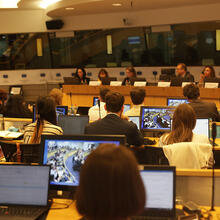
Together with Eurofound, Cedefop and the European Training Foundation (ETF), EU-OSHA is organising the Tripartite Exchange Seminar 2026 on digitalisation and artificial intelligence (AI), and the role of social dialogue.
This hybrid seminar will include two online sessions (in May and December 2026) and one in-person residential session in Brussels (planned for June 2026). It aims at assisting and enabling social partners to address the challenges of the digital and AI transitions in all forms of social dialogue.
Professionals working in national or subnational social partner and government organisations are invited to participate.
The deadline for applications is 8 December 2025. Apply now!

The dataset of EU-OSHA’s Fourth European Survey on New and Emerging Risks (ESENER 2024) is now freely accessible via GESIS. Recently released, it offers valuable insights into how European establishments manage occupational safety and health (OSH).
The survey focuses on psychosocial risks like stress, violence and harassment, and also shows the impact of digitalisation on OSH as well as the involvement of workers. ESENER covers all activity sectors, company sizes, and, combined with the datasets of previous survey waves, enables the analyses of trends over time.
Access and download the ESENER 2024 dataset
Discover the first findings of the latest ESENER survey
On the website several technical rules are published on the handling of asbestos. These include rules or best practice advice on risk assessment, different types of protective measures or on controlling the exposure levels. The guidance is well understandable and up-to-date.
This document is intended to inform and give practical preventive responses to carry out work on asbestos-bearing land, including civil construction and public works operations, whether the presence of asbestos is of natural origin or related to past human activities. It is aimed at all actors involved in work on these lands.


Does your business use dangerous substances?
Are you aware of the risks that dangerous substances pose to workers and the benefits of dealing with them?
This infographic introduces the basic facts, main risks and prevention measures. Find out about the guidance and many practical tools that can help you manage the risks.

Large enterprises often use more than 1,000 different chemical products (e.g. paints, inks, glues and cleaners) and millions of workers come into contact with chemical and biological agents that can harm them. However, many workers are not aware that they deal with dangerous substances.


In all sectors dangerous substances are present, be it in traditional sectors like agriculture, manufacturing or construction, or 'new and emerging' sectors like recycling or home care. New technologies, expanding sectors and changes to the way work is organised can result in greater risk of harm from chemical agents. Exposure to dangerous substances was reported in different sectors by these percentages:
62Agriculture, forestry and fishing 52Manufacturing 51Construction, waste management, and water and electricity supply

Certain groups of workers may be at greater risk of exposure to dangerous substances in the workplace because they are inexperienced, unaware or physically more vulnerable. People who frequently change jobs or are in temporary or informal work may also be at higher risk. Other workers may also be vulnerable at certain times for different reasons, for example when conducting high risk, non-routine work activity such as maintenance work.
Women
Young workers
Migrant workers
People in temporary or informal work
Workers lacking training and information

Exposure to carcinogens in the workplace causes the majority of fatal occupational diseases in the EU. Many of these deaths could be prevented. There are specific provisions in the EU to protect workers: according to the Carcinogens and Mutagens Directive, employers must assess and avoid or minimise the exposure to carcinogens or mutagens. EU-OSHA is one of the six partners supporting the Roadmap on Carcinogens initiative.
Around 1.6 million people of working age are diagnosed with cancer in Europe every year
More than 120,000 peopleper year are estimated to develop cancer in the EU as a result of occupational exposure to carcinogens
Approximately 80,000 deaths occur each year due to occupational exposure to carcinogens
About 53% of all work-related deathsare caused by carcinogens
2.4 billion € per year are the direct costs of exposure to carcinogens at work across Europe

Everyone benefits from efficiently managing dangerous substances in the workplace. Active, participatory safety and health management makes a business more competitive, for example by improving productivity.

The health problems that can be caused by working with dangerous substances range from mild eye and skin irritation to severe effects, such as birth defects and cancer. Effects can be acute or long term, and some substances can have a cumulative effect.
Skin diseases
Allergies
Respiratory diseases
Cancers
Reproductive problems and birth defects
Damage to the brain and the nervous system
Poisoning

To protect workers from dangerous substances, the first step is to carry out a risk assessment. Then, actions should be taken to remove or reduce the risks as far as possible. European worker protection legislation establishes a hierarchy of measures that employers need to take to control the risks of dangerous substances.
Elimination of the dangerous substances
Substitution by less dangerous substances, chemical products or processes
Technical measures, like exhaustion
Organisational measures, like separation of work places
Personal protective equipment

Dangerous substances can be found in nearly all workplaces. Across Europe, millions of workers come into contact with liquid, gas or solid agents that pose a risk to workers’ health or safety.
Prevention culture
Risk assessment
Prevention measures
Tools & Guidance
Legislation

