


The 2024 European Survey of Enterprises on New and Emerging Risks (ESENER 2024), provides valuable insights into how workplaces across Europe manage occupational safety and health (OSH). Conducted in over 41,000 establishments across 30 European countries, the survey reveals shifts in workplace practices, the impact of digitalisation and ongoing challenges in addressing traditional and psychosocial risks. The survey respondents are the persons who know best about how OSH is managed at the workplace.
Prolonged sitting, psychosocial risks and digitalisation top workplace safety and health concerns, new EU survey reveals
Press releases
Back to press releases
For immediate release - 07/02/2025 - 02:00 Europe/Madrid
Prolonged sitting, psychosocial risks and digitalisation top workplace safety and health concerns, new EU survey reveals
Image

The 2024 European Survey of Enterprises on New and Emerging Risks (ESENER) sheds light on the risks identified by European workplaces across all sectors, with prolonged sitting and repetitive movements remaining the top concerns. It also reveals psychosocial challenges and the growing impact of digitalisation on workplace safety and health, as organisations deal with new work practices.
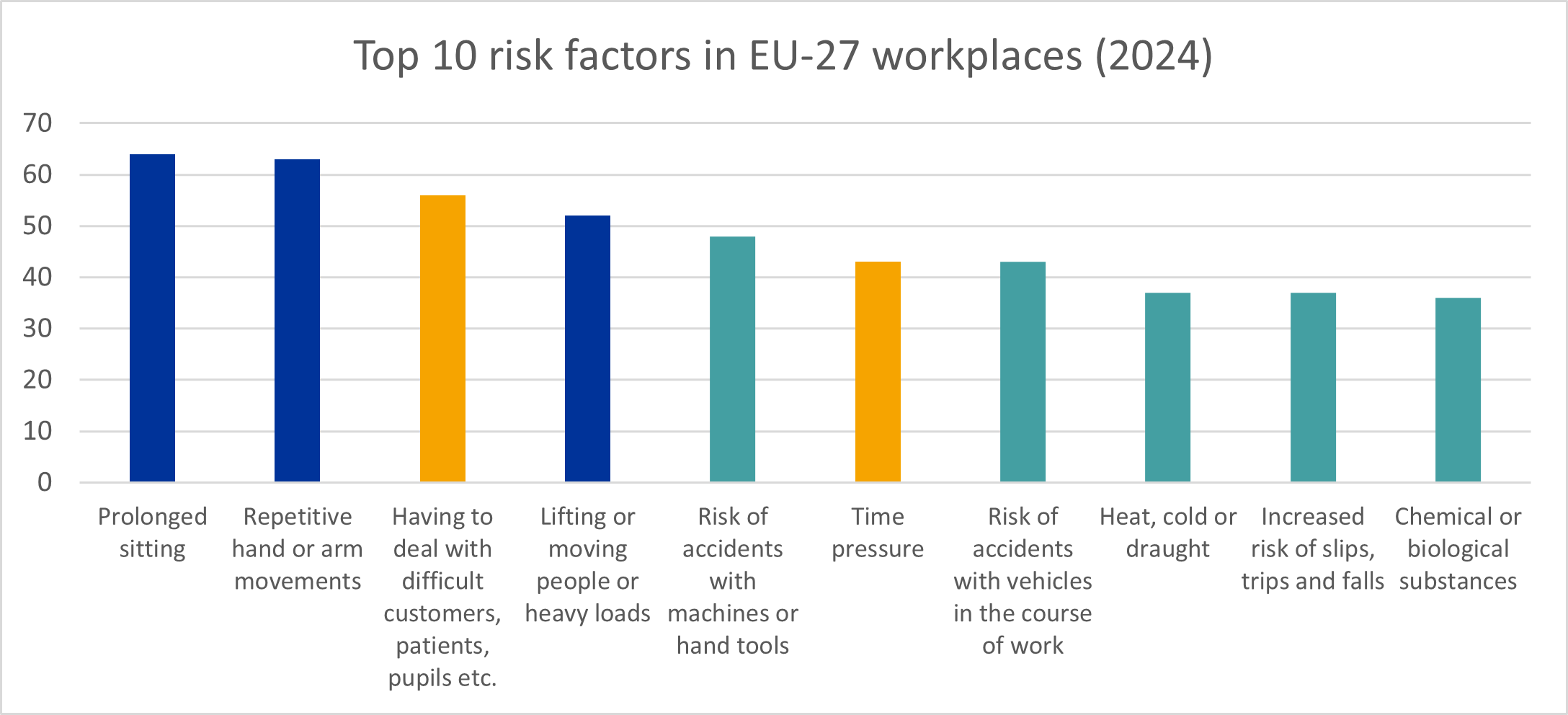
The survey uncovers the most frequently identified workplace risk factors, which appear to be relatively stable over time. As in 2019, the two top risk factors in 2024 are related to musculoskeletal disorders: prolonged sitting, which tops the ranking in the latest edition, was reported by 64% of workplaces, and repetitive hand or arm movements closely follows at 63%. Additionally, 52% cited lifting or moving people or heavy loads as a key risk factor.
What’s more, there has been a near doubling of establishments reporting employees working from home (up from 13% in 2019 to 23% in 2024), accompanied by growing awareness of the impact of digitalisation on worker safety and health.
Psychosocial risks are frequently present too, particularly in service sectors, with 56% of organisations identifying the challenge of dealing with difficult customers, patients or pupils.
Reflecting on the results, EU-OSHA Executive Director William Cockburn stated: “25% of organisations still fail to recognise the presence of psychosocial risks, highlighting a significant shortfall in addressing these important issues. This underlines the importance of our upcoming Healthy Workplaces Campaign, launching in 2026, which will focus on tackling the impact of psychosocial risks at work on workers’ mental health.”
Among workplaces reporting psychosocial risk factors, 21% perceive these risks to be more difficult to manage compared to other OSH risks. Figures vary significantly by country, with Nordic countries such as Sweden (38%) and Denmark (37%) perceiving higher challenges. Employee participation in designing measures to prevent psychosocial risks has seen a slight decline, dropping from 61% in 2019 to 55% in 2024.
Moreover, the survey shows increasing attention to digital technologies in workplace risk assessments, now covered in 43% of workplaces overall, with Spain and Slovenia leading the way with over 60%. Similarly, 42% of establishments offer training on the use of digital technologies, reaching 75% in Malta. ESENER also highlights risks factors linked to the use of digital technologies at work. Apart from musculoskeletal risks, companies report increased work intensity (34%), information overload (32%) and blurring boundaries between work and private life (27%).
Encouragingly, there has been a marked improvement in consulting workers about the impact of digitalisation on safety and health. Among establishments using at least one digital technology, 35% affirm consulting employees, up from 24% in 2019.
The first findings report marks the beginning of a series of analyses that will look deeper into the ESENER 2024 data, with detailed results to be published in subsequent reports by 2026.
Links:
Notes to editor:
The European Agency for Safety and Health at Work (EU-OSHA) contributes to making Europe a safer, healthier and more productive place to work. The Agency researches, develops, and distributes reliable, balanced, and impartial safety and health information and organises pan-European awareness raising campaigns. Set up by the European Union in 1994 and based in Bilbao, Spain, the Agency brings together representatives from the European Commission, Member State governments, employers’ and workers’ organisations, as well as leading experts in each of the EU Member States and beyond.
Now you can follow us on LinkedIn, Facebook, Bluesky, YouTube, Flickr or subscribe to our monthly newsletter OSHmail. You can also register for regular news and information from EU-OSHA via RSS feeds.