


EU-OSHA Blog
Back to latest postsEU-OSHA continues supporting the Albanian State Labour Inspectorate and Social Service with a training session on chemical safety
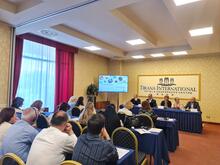
On 20 May 2025, EU-OSHA delivered another training session, targeted to the Albanian Labour inspectors, focused on the EU OSH prevention principles related to exposure to chemical agents.
Within the framework of the EC-funded IPA Action 2023-2025 and following the request of the Albanian Focal Point (SLISS), EU-OSHA organised the second capacity building activity for the Albanian Labour inspectors focusing on the prevention of OSH risks related to chemical agents in the workplace.
The event was opened by Irida Qosja, SLISS deputy Chief inspector, who thanked EU-OSHA for the continuous and important capacity building support. Miha Pezelj, team leader for Economic and Social Development at the EU Delegation to Albania, underlined that the implementation of the EU approximated legislation is fundamental for the EU accession of Albania and that EU-OSHA can strongly contribute to strengthen the enforcement capacities of the national authorities. EU-OSHA introduced the main principles of the Directive 98/24/EC on chemical agents and Lothar Lieck (former EU-OSHA project manager) presented EU comparative data on chemical prevention and best practice from EU Member States regarding substitution of hazardous substances in the workplace. Eda Beqiri, Chief sector of OSH surveillance and FOP manager, presented practices and difficulties on inspection of chemical agents in Albania, underlining that the Albanian legislation has a high degree of EU acquis transposition, but implementation is not yet effective. The new OSH strategy 2025-2030, prepared with the support from ILO and the EC-funded ESAP3 project, aims at filling legislative gaps and at shifting focus from EU acquis transposition to implementation and enforcement. For this reason Labour inspectors have an important responsibility in supporting the OSH full alignment. The training session was concluded with practical exercises where participants had to work in groups, and solve issues concerning verification of information sources for chemical substances, adoption of a best-fit-for-use practical approach and verification of SDS to provide opinions on quality.
The training proved to be very important and had a very positive feedback by the 50 participating Labour inspectors, representing the central Labour inspectorate as well as all regional Labour inspectorates.