



© Andrey Popov - stock.adobe.com
This project explores how labour inspectorates and prevention services in Germany, Ireland, Norway, Poland, and Portugal help strengthen occupational safety and health (OSH) compliance. Drawing on qualitative research and interviews, it shows how digital innovation, collaboration and capacity building are driving new solutions to today’s OSH challenges. The findings highlight key areas for progress ─ from better policy and data systems to stronger prevention efforts and improved support for vulnerable worker groups.
Key findings
- Digitalisation and data-driven targeting are maximising the effectiveness of inspections as all five countries face challenges related to inspector-to-workforce ratios and limited OSH resources.
- Enforcement is shifting from a purely “command and control” model toward supportive, promotional approaches that reflect the realities of different enterprises.
- Strong collaborative networks are essential ─ no single institution can tackle OSH challenges alone, especially when reaching SMEs and vulnerable workers.
- Remote and digital support approaches and tools, from video consultations to AI chatbots, have become a permanent part of OSH systems.
- Sustainable OSH improvements depend on building internal capabilities among employers and workers through strategies tailored to different contexts and target groups.
Implications for policymakers and practitioners
- Strategies must be flexible and tailored to different contexts ─ there is no one size fits all solution.
- A portfolio approach is essential, combining multiple strategies.
- There are still significant gaps in evidence-based design, monitoring and evaluation of interventions.
- Despite advances in technology, human expertise, judgement and relationships remain crucial.
- Final message: By working together and combining digital innovation with human insight, we can strengthen OSH systems and create safer, healthier workplaces across Europe.
Related publications
Related publications
10/03/2026
Type:
Reports
170 pages
23/06/2025
Type:
Discussion papers
16 pages
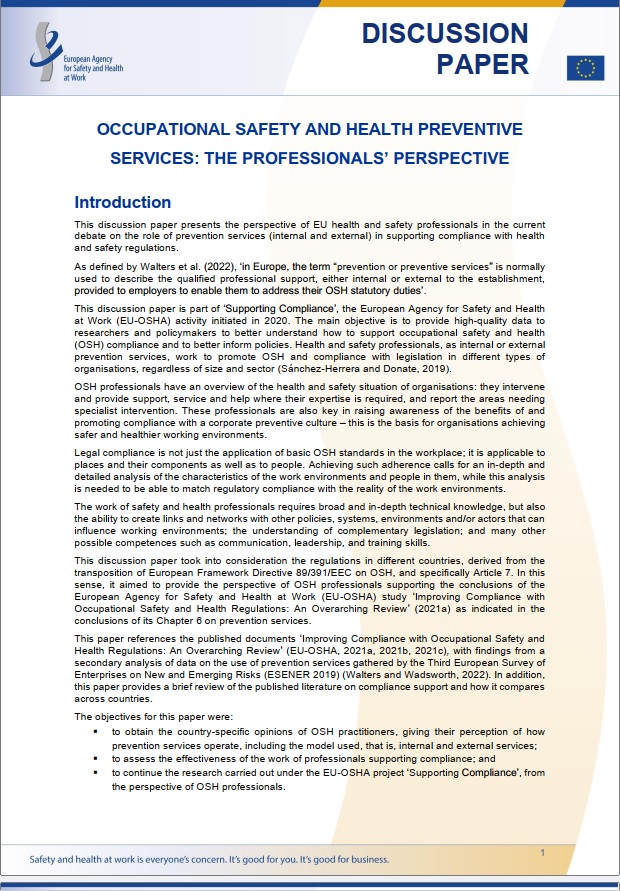
13/06/2024
Type:
Discussion papers
13 pages

02/02/2023
Type:
Discussion papers
19 pages

18/01/2023
Type:
Discussion papers
19 pages