79% of European managers are concerned by work-related stress, but less than a third of companies have set procedures to deal with it
News release - 03.06.2010
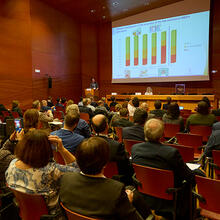
Concern about psychosocial risks such as stress, violence and harassment is increasing in European organisations, the first findings of the biggest workplace health and safety survey in Europe show. The new data was released on 3 June 2010 by the European Agency for Safety and Health at Work (EU-OSHA) at the mid-term review conference of the Community Strategy for Health and Safety at Work (2007 - 2012).
Psychosocial risks concern most European companies
Four out of five European managers express their concerns about work-related stress, the ‘European Survey of Enterprises on New and Emerging Risks’ (ESENER) reveals, making stress at work as important as workplace accidents for companies (79%). Work-related stress is very acute in health and social work (91% of companies regard it as of some or major concern) and in education (84%).
“With the financial crisis in full swing, 79% of European managers voice their concern about stress at work, which is already recognised as an important burden on European productivity”, said EU-OSHA Director Jukka Takala at the conference in Barcelona. “But despite the high levels of concern, it is clearly worrying that only 26% of EU organisations have procedures in place to deal with stress. The ESENER survey highlights the importance of providing effective support for enterprises to tackle stress, which will be crucial in ensuring we have the healthy productive workforce needed to boost European economic performance and competitiveness”.
The survey also shows that 42% of management representatives consider it more difficult to tackle psychosocial risks, compared with other safety and health issues. The sensitivity of the issue (53%) and lack of awareness (50%) are the main barriers for dealing effectively with psychosocial issues, according the findings.
Workers’ involvement is a key factor in health and safety management
ESENER shows that workplaces with employee participation are much more likely to see successful health and safety measures implemented. This is particularly the case for smaller workplaces where it is an important trigger for effective management of psychosocial risks.
In fact, 84% of companies with formal on-site employee representation have an occupational safety and health (OSH) policy or action plan, compared to only 71% of companies without formal representation. Measures to deal with psychosocial risks such as violence, stress and bullying are applied about twice as frequently by enterprises consulting their employees than by those designing their measures without the participation of employees.
Small size need not be an obstacle to effective risk management
ESENER found that the main barriers for dealing with health and safety issues are lack of resources (36%) such as time, staff or money and lack of awareness (26%).
Survey evidence also shows that even smaller companies are able to carry out in-house risk assessment, but need support in the form of expertise, guidance and tools to manage their risk management process effectively and to design and implement successful preventive measures.
Through its campaign and information services EU-OSHA is working to raise awareness on workplace hazards and promote comprehensive and integrated risk management. EU-OSHA makes available a number of products to make this process easier, especially for small and medium-sized enterprises (SMEs). A new ‘Risk Assessment Tools Database’ brings together checklists, handbooks, brochures, questionnaires and interactive tools from across
Europe, and is freely available from the website. An ‘Online interactive Risk Assessment tool’ (OiRA) is currently being developed and should encourage and help many thousands of European SMEs across all sectors to carry out risk assessments.
In the context of the Community Strategy for Health and Safety at Work (2007-12), it is important to know how workplace risks can be successfully managed and what the obstacles can be to achieving this, so that future OSH strategies can be better planned and supporting measures are tailored to companies’ needs. The ESENER survey is a unique pan-European indicator of OSH performance that should assist policy-makers evaluate the progress and implementation of the Strategy.
The full ESENER report and a summary in 22 languages are available from our website. View the results online with the interactive mapping tool at www.esener.eu.
Links:
ESENER Summary (available in 22 languages)
Mapping tool (available in 22 languages)
Notes to editors:
1. The European Survey of Enterprises on New and Emerging Risks (ESENER) was conducted by TNS Infratest in spring 2009. The survey covers 31 European countries, including all 27 EU Member States, Croatia, Turkey, Norway and Switzerland. 36,000 interviews with managers and health and safety representatives were conducted in establishments with ten or more employees from both private and public organisations across all sectors (except for agriculture, forestry and fishing).
Taking in the views of managers and workers’ representatives from across Europe, the survey provides key information on how European companies currently manage health and safety issues with a particular focus on the relatively new psychosocial risks, such as work-related stress, violence and bullying.
The findings help to identify the factors that encourage measures to be taken and those that discourage or impede it. It shows what support companies may require to develop effective procedures and how workers can get involved in this process. With this, the survey improves the targeting of measures on new and emerging risks. ESENER helps enterprises to define their needs according to their characteristics (size, sector, location etc.) and furthermore assists workplaces across Europe to deal more effectively with OSH and promotes the well-being of all employees.
ESENER, as the first pan-European survey focusing on new and emerging risks, provides policy makers with cross-nationally comparable information and is of great importance both in measuring progress in this policy field and also to actively contribute to policy-making (e.g. future EU Strategies).
The questionnaires were developed by a team comprising experts in survey design and in OSH (particularly psychosocial risks), together with EU-OSHA staff. In addition, a tripartite Advisory Group, comprising members of EU-OSHA’s Governing Board and Bureau, played an important role in identifying useful questions for the Agency’s stakeholders.
Further analysis will be carried out in 2010 and four more reports will be following, focusing on success factors related to health and safety management, psychosocial risks management, involvement of workers and actions, drivers and barriers to psychosocial risk management.
2. The mission of the European Agency for Safety and Health at Work (EU-OSHA) is to make Europe a safer, healthier and more productive place to work. EU-OSHA was set up by the European Union to help meet the information needs in the field of occupational safety and health. Based in Bilbao, Spain, EU-OSHA aims to improve the lives of people at work by stimulating the flow of technical, scientific and economic information between all those involved in occupational safety and health issues.
Now you can follow us on Twitter, visit the Agency’s blog or subscribe to our monthly newsletter OSHmail. You can also register for regular news and information from EU-OSHA via RSS feed.
Press inquiries
- Birgit Müller - International press +34 94 479 35 52 | news@osha.europa.eu
- Marta Urrutia - Spanish press +34 94 479 57 46 | noticias@osha.europa.eu
- Brenda O’Brien - Brussels Liaison Office +32 2 401 68 59 | obrien@osha.europa.eu